1.Causes and Types of Scale‑Formation
Reverse‑osmosis membrane separation is a sophisticated liquid‑separation membrane technology. It can remove most dissolved salts in aqueous solutions as well as organic substances with molecular weights above 100. Commercially available industrial composite RO membranes normally achieve a sodium‑chloride rejection rate exceeding 99%.
Dissolved‑salt compositions vary widely for different feed‑water sources. After feed‑water undergoes desalination and concentration within the reverse‑osmosis system, the salt concentration on the concentrate‑side rises multiple‑fold, compounded by concentration‑polarization effects. Once salt concentrations exceed their solubility limits, precipitates build‑up and form scale deposits on membrane surfaces. Higher system recovery rates and greater concentration‑polarization factors lead to an elevated risk of scaling on membranes.
Common sparingly‑soluble scale types in RO systems include calcium carbonate, calcium sulfate, barium sulfate, calcium fluoride and silicate scale. Four primary factors trigger scaling in reverse‑osmosis systems:
1.Concentrations of sparingly‑soluble salts in feed water exceed solubility‑product limits without antiscalant dosing;
2.Improper antiscalant selection and inaccurate dosage control;
3.Excessively‑high set‑up recovery rate;
4.Poor control of operating parameters. For instance, raising pH‑values to mitigate silicate scale will aggravate calcium‑carbonate precipitation.
2. Hazards of Scaling and Prevention‑Control Measures
Once reverse‑osmosis membranes suffer from scale fouling, typical operational symptoms include reduced permeate flow, lower salt‑rejection rate, elevated operating pressure and rising stage differential‑pressure across membrane elements. Scaling usually first occurs on the last membrane element of the final stage and then gradually spreads to upstream stages.
When feed‑water contains calcium, bicarbonate and sulfate ions, membrane blockage by scale will happen within a short period. Scale formed from barium and fluoride ions develops much slower because their baseline concentrations in raw‑water are generally low.
Field inspection methods for confirming scaling: Remove the last membrane element from the final‑stage pressure vessel; scale deposits can be visually observed on the end‑face of membrane elements and end plates of the pressure vessel. Drain off residual water and weigh the element, its weight will be distinctly higher than a brand‑new one (standard weight for a new element is around 13.5 kg).
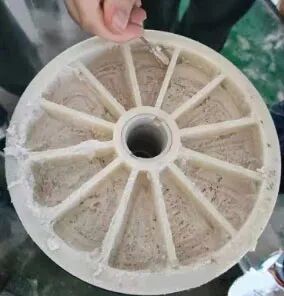
Dissect the fouled membrane element taken from the final‑stage. Crystal structures of scale can be observed under a microscope. Chemical titration analysis or X‑ray diffraction (XRD) testing can accurately identify scale types and material compositions.
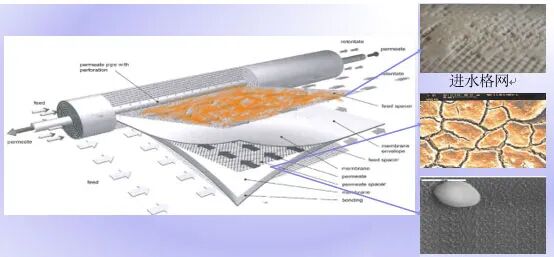
A targeted scale‑prevention plan shall be formulated according to raw‑water quality. General fundamental control measures widely adopted in this industry are as follows: adjusting feed‑water pH by acid dosing during pretreatment; continuously adding RO‑specific antiscalants; removing or reducing sparingly‑soluble salts via pretreatment processes such as hardness‑removal with ion‑exchange resins, softening by chemical precipitation, silica removal as well as iron and manganese elimination.
3.Antiscalant Dosing‑One of Scale‑Prevention Technologies
When the solubility‑product of sparingly‑soluble salts on the concentrate side of reverse‑osmosis reaches saturation or supersaturation, antiscalant dosing becomes the most widely‑adopted anti‑scale method. Proper selection and accurate dosing of antiscalants play a decisive role in scale‑inhibition performance.
a) Antiscalant Selection
Commercially qualified RO‑specific antiscalants from reputable manufacturers mainly fall into two categories: organophosphonates and polyacrylates, which deliver reliable scale‑inhibition performance. The chemical supplier’s dedicated calculation software can be used to compute theoretical dosage and saturation‑inhibition capacity.
Anionic organic antiscalants tend to react with cationic polyelectrolyte flocculants added during pretreatment and high‑valent metal ions such as iron and aluminum in raw water to form flocs and subsequently cause membrane fouling; hence over‑dosing is prohibited. Cationic polymers shall not be added excessively or even avoided in pretreatment so as to prevent precipitant contaminants generated after their reaction with antiscalants.
Whichever brand or model of antiscalant you select, a complete raw‑water quality analysis report and full set of RO system design parameters must be provided to the supplier to make sure the chemical matches practical on‑site operating conditions.
b) Proper Design and Regulation of Antiscalant Dosing System
Prevent biased chemical distribution: Install the dosing point upstream of the cartridge filter together with a pipeline mixer to achieve full and even blending between antiscalant and feed‑water.
Follow standard dilution ratio: Dilution factors must comply strictly with manufacturer guidelines. Excessive dilution will trigger microbial growth and block metering pump pipelines as well as membrane elements.
Linked adjustment for the dosing unit: The metering pump can adjust the injection volume synchronously when RO working conditions change. This avoids scaling caused by insufficient antiscalant and prevents membrane fouling plus extra operating costs resulting from over‑dosing.
c) Interlock Control of Antiscalant Metering Pumps
Metering pumps shall be interlocked with high‑pressure pumps: the metering pump starts simultaneously with the high‑pressure pump and shuts down right after the high‑pressure pump stops.
Common faults of dosing systems include clogged inlet strainers of metering pumps, gas lock from accumulated air inside dosing pipelines, non‑standard installation of metering pumps, pump output pressure lower than system back‑pressure, diaphragm rupture with liquid leakage, and insufficient actuator power failing to reach rated output pressure. Routine inspection and maintenance of the whole dosing system are required during daily operation.
d) Suggestions on System Maintenance and Management
Keep complete daily‑operation logs, calibrate online monitoring instruments and verify actual output of metering pumps regularly.
Each shift checks the liquid level of the antiscalant tank on schedule to maintain steady chemical supply, and calculates the dosing concentration according to real‑time permeate flow.
Perform regular monitoring for water quality and operational parameters and conduct preventive chemical cleaning periodically.
Shut down the system timely to find root causes if operating data fluctuates abnormally, then carry out targeted chemical cleaning based on scale types.
Before adjusting RO operating settings (especially permeate output and recovery rate), calculate water‑quality saturation index to confirm feasibility and update the antiscalant dosage accordingly.