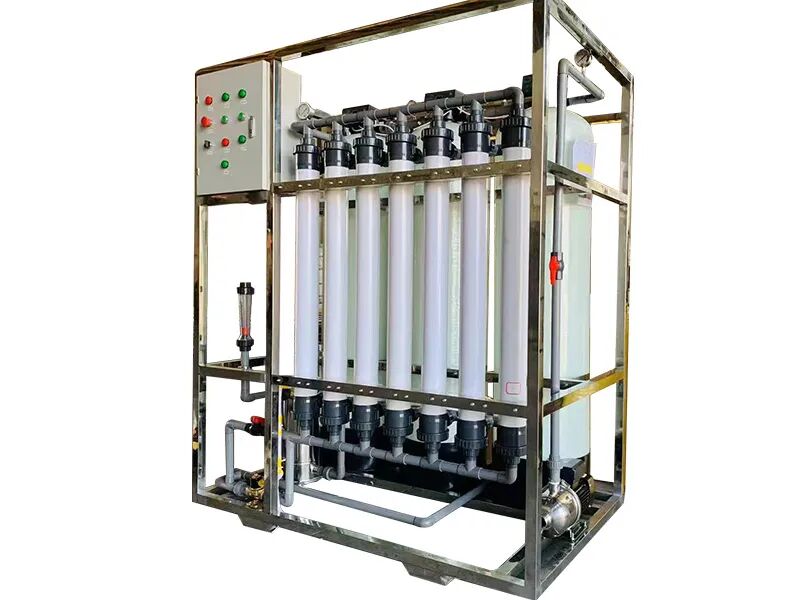
After ultrafiltration chemical cleaning, permeate flow and transmembrane pressure difference recover temporarily, yet they drop sharply within several hours of operation. This is a very typical membrane failure condition encountered on-site.
Feed water quality shall be prioritized during troubleshooting, but it is not the sole cause. Such issues are mostly triggered by shock loads of contaminants in feed water or hidden hazards left after chemical cleaning.
Combined with practical field operating conditions, this article sorts out accurate failure root causes, verification schemes, solutions and stepwise troubleshooting procedures. The content is tailored to frontline operation practice and can be directly referenced on site.
I. Five Core Root Causes of Malfunction
01 Sudden Shock of Feed Water Quality (Primary Cause)
Sudden surges of suspended solids, colloids and organic matter in feed water lead to breakthrough failure of pretreatment equipment, causing rapid fouling and blockage of membrane layers within a short period.
Symptoms: Excessive feed water turbidity and SDI; breakthrough failure of pre-filters
Troubleshooting & Solutions: Rush to test feed water turbidity and SDI; backwash pre-filters and optimize coagulant dosage; temporarily reduce system recovery rate and permeate output if necessary.
02 Incomplete Cleaning & Residual Chemical Agents
Only loose contaminants on the membrane surface are removed, while deep-seated biofilm and inorganic scale inside the membrane fail to be fully stripped. Coupled with incomplete flushing of residual chemicals, contaminants are rapidly re-adsorbed to block the membrane during operation.
Symptoms: Stable performance in short-term operation, followed by sharp rebound of differential pressure within several hours
Troubleshooting & Solutions: Observe the state of cleaning waste liquid and verify whether the initial transmembrane pressure after cleaning meets standards; adopt segmented cleaning with a strict sequence of alkaline cleaning first then acid cleaning, extend soaking duration to thoroughly remove deep contaminants and flush out all residual chemicals.
03 Mass Propagation of Microorganisms
Inadequate sterilization during cleaning, together with nutrient substances for microbes contained in feed water, result in rapid reproduction of residual bacteria, which secrete sticky extracellular polymeric substances (EPS) to clog membrane pores.
Symptoms: Extremely fast permeate decay, sticky and odorous membrane fibers, excessive bacteria and TOC in effluent
Troubleshooting & Solutions: Test total bacterial count of inlet and outlet water; add 100–200 ppm sodium hypochlorite for sterilization during cleaning, and flush until no residual chlorine remains in the system. Meanwhile, inspect dead zones of pipelines to eliminate blind spots for disinfection.
04 Abnormal Backwashing / Operational Flux Parameters
Insufficient backwash intensity or frequency: Residual contaminants trapped at the root of membrane fibers get compacted and block membranes during operation.
Excessively high operational flux: Exceeds the designed load of membranes and drastically accelerates contaminant accumulation.
Troubleshooting & Solutions: Compare on-site operating parameters with design values provided by the membrane manufacturer; increase backwash intensity or frequency. Avoid full-load operation immediately after cleaning, and moderately lower operational flux to mitigate fouling.
05 Tiny Damage to Membrane Fibers / Seals
Excessively high air scrubbing pressure during cleaning and pipeline water hammer impact trigger microcracks on membrane fibers and minor leakage of seals. Raw water contaminants accumulate rapidly at damaged positions.
Symptoms: Rising permeate turbidity, irregular fluctuation of differential pressure
Troubleshooting & Solutions: Conduct membrane integrity bubble point test; plug broken fibers and replace seals; replace membrane modules if damage is severe.
II. Four-Step Simplified Troubleshooting Procedure (From Simple to Complex, Time-Saving & Efficient)
Inspect feed water quality: Test turbidity and SDI. If indicators exceed standards, repair the pretreatment system as a priority.
Check the cleaning process: Verify chemical dosage, soaking time and flushing sequence to identify incomplete cleaning issues.
Calibrate operating parameters: Check flux and backwash settings to prevent overloaded operation.
Test membrane integrity: Perform a bubble point test to detect hardware damage only if no abnormalities are found in the first three steps.
III. Quick Fault Judgment Mnemonic (Locate Faults Simply by Monitoring Differential Pressure)
Permeate flow drops + differential pressure surges simultaneously → Overall fouling on membrane surface
Permeate flow drops + differential pressure remains nearly unchanged → Internal pore blockage or feed channel obstruction
Rapid performance decay shortly after ultrafiltration cleaning is rarely caused by end-of-membrane service life. Instead, it mainly stems from feed water contaminant shock, improper operation and maintenance, or unreasonable parameter settings.
Blind and frequent membrane cleaning will only damage membrane elements and raise O&M costs. Troubleshooting in the sequence of feed water quality → cleaning procedure → operating parameters → membrane integrity enables root-cause resolution and extends membrane service life.