For circulating water and boiler water treatment, hardness and alkalinity are indispensable when reviewing water quality reports. Many people assume they rise and fall in tandem, yet they are fundamentally different, even though they often appear together.
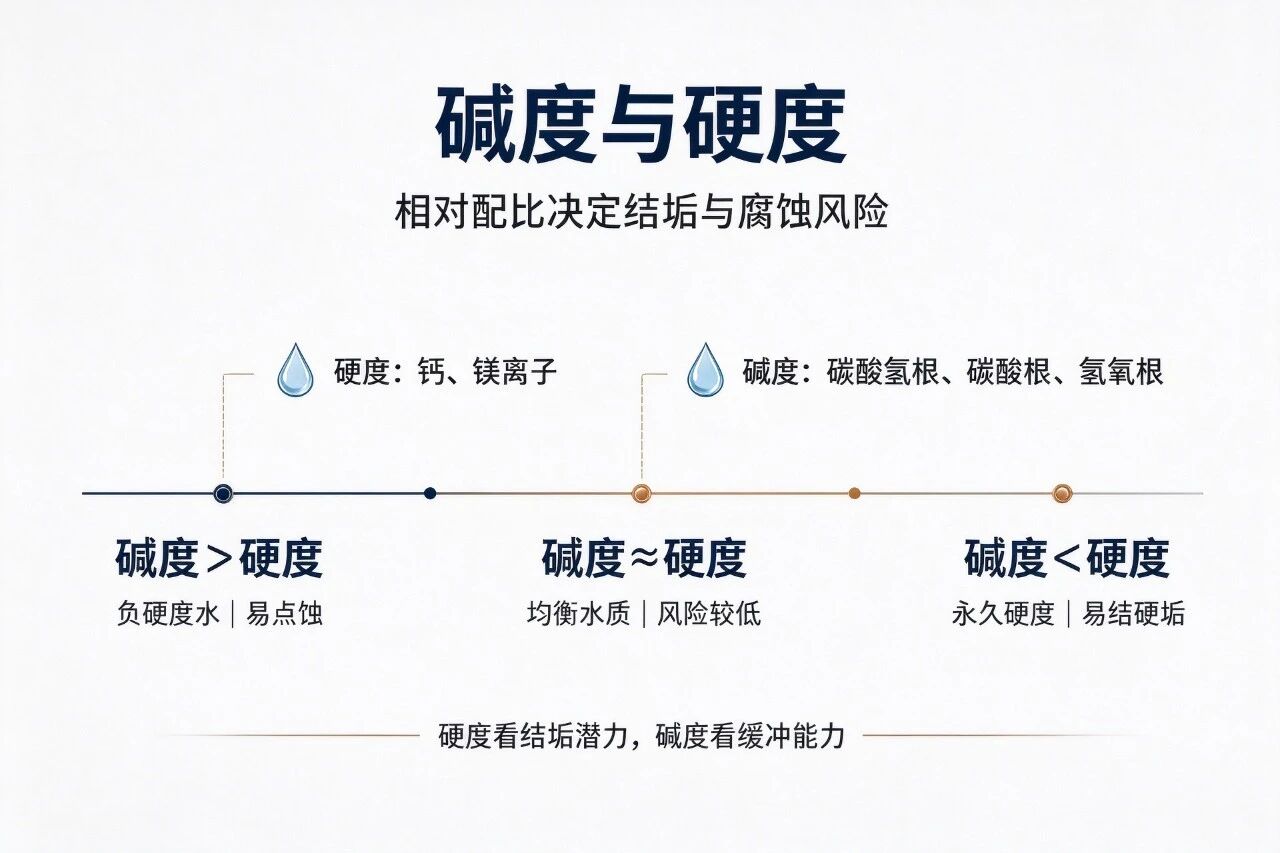
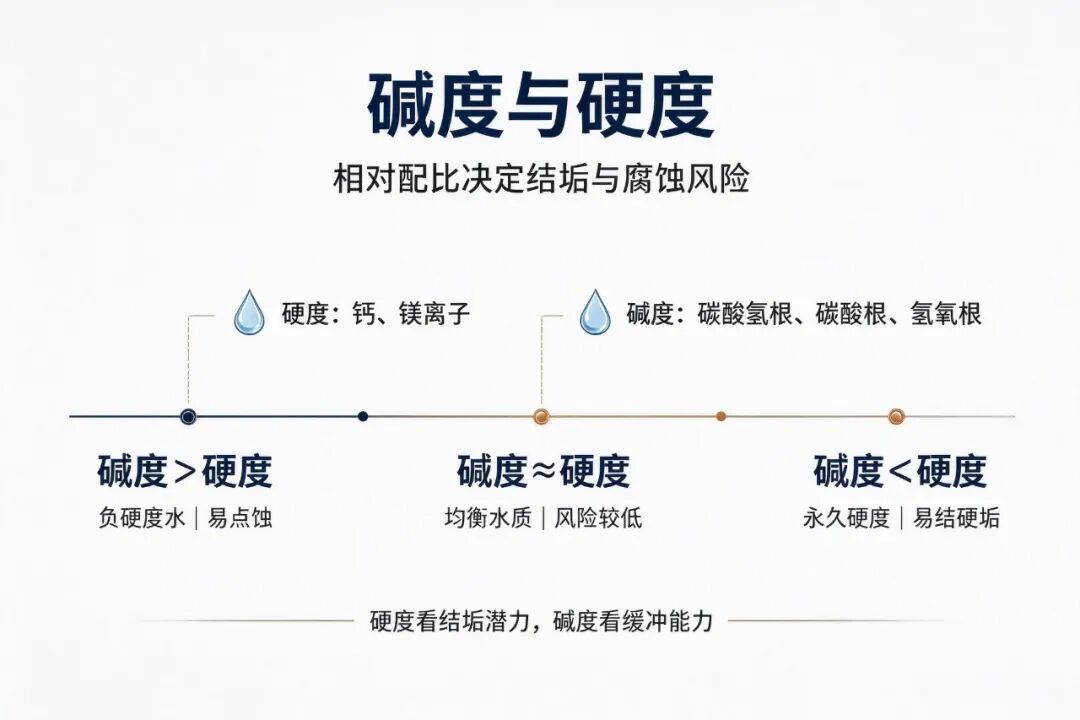
Hardness: The total concentration of calcium and magnesium ions in water, which governs scaling potential, expressed as CaCO₃. It only concerns calcium and magnesium cations.Alkalinity: Alkaline substances capable of neutralizing strong acids (bicarbonate, carbonate, hydroxide, etc.), which determine the pH buffering capacity of water. It only refers to alkaline anions. There is no fixed correlation between the two.
Total Alkalinity > Total Hardness (Negative Hardness Water)All calcium and magnesium exist as bicarbonates. Excess alkalinity comes from sodium and potassium salts. Scaling risk is low, but pitting corrosion is likely.
Total Alkalinity = Total HardnessOnly calcium and magnesium bicarbonates are present. No permanent hardness or excess alkalinity. Both corrosion and scaling risks are moderate, representing balanced water quality.
Total Alkalinity < Total HardnessBicarbonate is insufficient to bind all calcium and magnesium. Remaining calcium and magnesium exist as sulfates and chlorides, known as permanent hardness. Hard scale readily forms upon heating.
Temporary hardness (calcium and magnesium bicarbonates) is where the two parameters overlap. Upon heating, it decomposes to precipitate calcium carbonate scale, with both hardness and alkalinity decreasing simultaneously. This is the primary cause of boiler scaling.
Alkalinity shapes the form of scale:
Low alkalinity with high hardness tends to form hard scale such as calcium sulfate and calcium silicate.
Proper alkalinity produces loose calcium carbonate sludge that can be removed via blowdown.
Corrosion balance: Water with low hardness and low alkalinity has poor buffering capacity and is prone to acid corrosion. Negative hardness water with low hardness and high alkalinity tends to suffer pitting corrosion.
Softening is not simply about lowering readings:
Single sodium softening: Reduces hardness while alkalinity stays at the inlet level, widely used for makeup water of circulating systems.
Sodium-hydrogen ion exchange series: Deep hardness reduction with alkalinity stabilized within the target range, suitable for high-pressure boilers.
Lime-sodium softening: For high-hardness raw water; regulates both hardness and alkalinity at the same time.
Two-stage sodium softening: Advanced hardness removal, adopted as pre-treatment for ultra-pure water.
❌ High hardness equals high alkalinity: Gypsum-bearing groundwater is typically high-hardness and low-alkalinity; effluent from sodium softening has low hardness with unchanged alkalinity. ❌ Higher alkalinity means better water quality: Excessively high alkalinity in boilers causes caustic embrittlement and priming. ❌ Zero hardness means no scaling: Silicon, iron and aluminum can still form silicate scale under high alkalinity and high pH.
Hardness reflects scaling potential; alkalinity reflects pH buffering capacity. To assess water risks, always compare the relative values of hardness and alkalinity, then select appropriate alkalinity adjustment, softening and blowdown strategies to balance scaling and corrosion.