Ion exchange resin serves as the core consumable for water softening and pure water projects. However, many water treatment engineers have run into costly pitfalls with resin. Sizing resin based solely on experience from old projects or rough estimates often leads to two common problems: insufficient resin loading results in short service runs, frequent regeneration and heavy maintenance workloads; over-purchasing resin ties up capital and creates waste. Worse still, confusing hardness reduction (softening) with full desalination leads to fundamental design errors, with extremely high rectification costs later on. When selecting resin, do not focus on price first — start with influent water quality and treated water requirements!
Resins for softening, conventional desalination and ultrapure water applications differ significantly and must not be used interchangeably.
✅ Softening Systems (Boiler Make-up Water, Circulating Water, RO Pre-treatment)001×7 sodium-form strong acid cation exchange resin is the preferred choice. Function: Replace calcium and magnesium ions in water to reduce hardness and prevent scaling on pipelines and membrane elements. ⚠️ Critical Note: Softening ≠ total salt removal Calcium and magnesium ions are merely exchanged for sodium ions, while the total dissolved solids (TDS) of water remain largely unchanged. ???? For RO membrane protection and hardness control only: 001×7 Na-form resin is sufficient. ???? If reduction of total salt content is required, softening alone cannot meet the target.
Resin variant selection by source water:
Tap water and conventional surface water with low organic content: Gel-type 001×7
Surface water with high organic load and high fouling risk: Macroporous 001×7D Note: Macroporous resin offers better fouling resistance but has a slightly lower exchange capacity. It cannot replace gel-type resin unconditionally.
❗ Top Priority: Residual chlorine must be removed upstream Residual chlorine oxidizes resin, causing bead breakage and permanent failure. Without activated carbon pre-treatment for dechlorination, resin service life will be drastically shortened, regardless of resin grade.
✅ Cation-Anion Bed Desalination Systems (Production of General Desalted Water)A combined cation bed + anion bed process is required to remove a wide range of dissolved ions.
Cation bed: 001×7 H-form cation resin to remove cations including calcium, magnesium, sodium and potassium.
Anion resin selection based on treated water silicon specification:
Strict silicon requirement: 201×7 strong-base anion resin, capable of removing sulfate, chloride, nitrate and silicate for deep desalination and the pre-treatment stage of ultrapure water.
Loose silicon requirement: A combination of D301 weak-base anion resin and 201×7 strong-base anion resin can be adopted to cut alkali consumption for regeneration. Note: D301 only removes strong acid anions; it cannot remove silica or carbon dioxide and is not a universal anion resin. Reduced regenerant dosage is acceptable only if treated water quality meets specifications.
✅ Ultrapure Water SystemsWater produced from a cation bed (001×7 H-form) + anion bed (201×7) can be further polished by EDI. For final advanced polishing, pre-mixed cation-anion polishing mixed bed resin is used. At 25°C, the product water resistivity can reach up to 18.2 MΩ·cm. Note: Most polishing resins cannot be regenerated on-site, leading to high procurement and maintenance costs. They are not a substitute for conventional upstream cation and anion beds. Ultrapure water lines in the electronics industry normally adopt staged treatment to control consumable costs.
✅ Specialized Resins for Challenging Water QualityDo not use standard resin for water with specific contaminants:
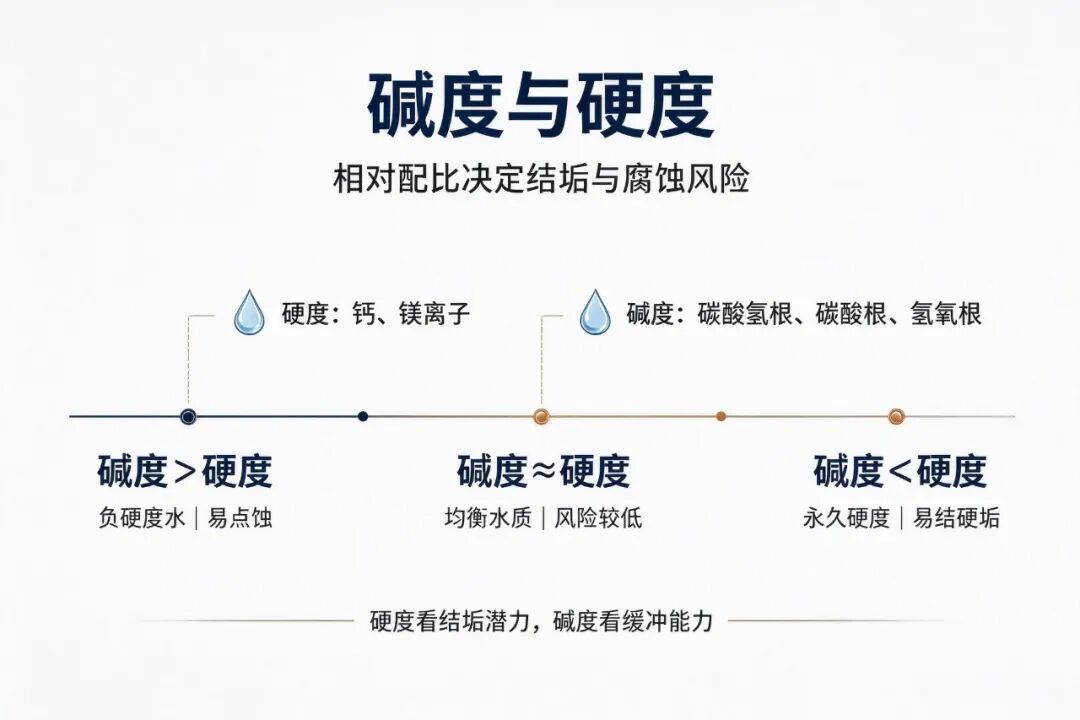
High alkalinity feedwater: D113 weak-acid cation resin, which preferentially removes carbonate (temporary) hardness and has limited effect on permanent hardness.
Electroplating wastewater / excessive heavy metals: D403, D418 chelating resins.
Excessive nitrate or fluoride: Corresponding selective specialty resins. Note: Before specifying specialty resins, confirm target ions and influent concentrations. Do not select special resin blindly just because water quality is poor.
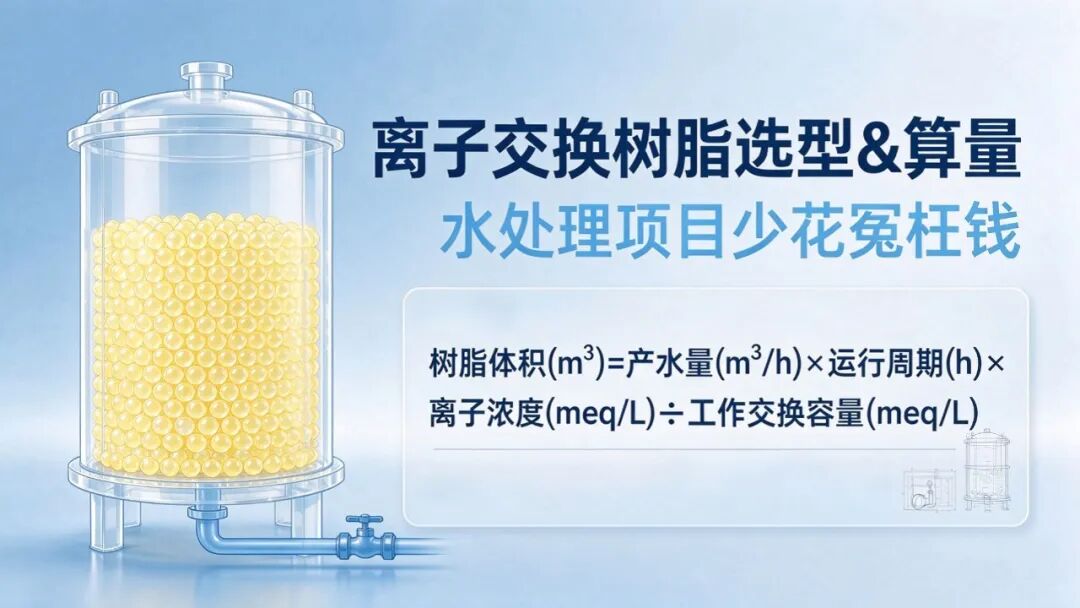
Core Formula for Resin Loading Volume
Resin Volume (m³) = Flow Rate (m³/h) × Run Length (h) × Ion Concentration to be Removed (meq/L) ÷ Resin Working Exchange Capacity (meq/L)
???? Engineering Example Softener influent hardness: 3.0 meq/L; Flow rate: 5 m³/h; Designed regeneration interval: 8 h; Working exchange capacity: 900 meq/L Resin Volume = 5 × 8 × 3 ÷ 900 = 0.133 m³ (133 L resin)
Note: The working exchange capacity is an empirical engineering value affected by regeneration regime, salt/alkali dosage and influent quality, not a fixed constant. The value of 900 meq/L used here is a common reference for softening systems.
⚠️ Practical Tips
Consistent units are essential; convert flow and ion concentration properly.
Calculated results are theoretical references only. Recheck against water quality fluctuation, regeneration process and site conditions before final design.
Resin loading volume normally accounts for 40%–60% of the vessel’s effective volume. Bed depth is generally controlled at 0.8–1.6 m, with sufficient headspace reserved for backwash expansion.
Cation resin backwash expansion ratio: ~1.5 times
Anion resin backwash expansion ratio: 1.8~2 times Extra headspace at the top of anion beds is particularly critical.
Check superficial velocity to avoid early ion breakthrough:
Softener: 20~30 m/h
Cation bed & anion bed for desalination: 15~25 m/h Excessively high velocity reduces contact time between water and resin and easily causes early breakthrough and out-of-spec effluent.
Anion resin is highly susceptible to iron fouling: Where raw water contains high iron, install iron removal equipment and multimedia filters upstream. Iron fouling persistently degrades anion resin capacity and shortens service life.
Pre-treatment acts as the protective barrier for resin: Resin is not a universal filter. Multimedia filtration, activated carbon dechlorination, iron removal and other pre-treatment steps are indispensable. Even premium resin will fail rapidly without proper pre-treatment.
Resin selection is not about buying the most expensive product. Step 1: Clarify target ions for removal, influent parameters and treated water specifications. Step 2: Match the correct resin grade. Step 3: Calculate loading volume, then verify expansion space inside the vessel and operating velocity. Solid resin selection and sizing avoid resin waste, frequent regeneration and substandard effluent, cutting consumable costs at the design stage.