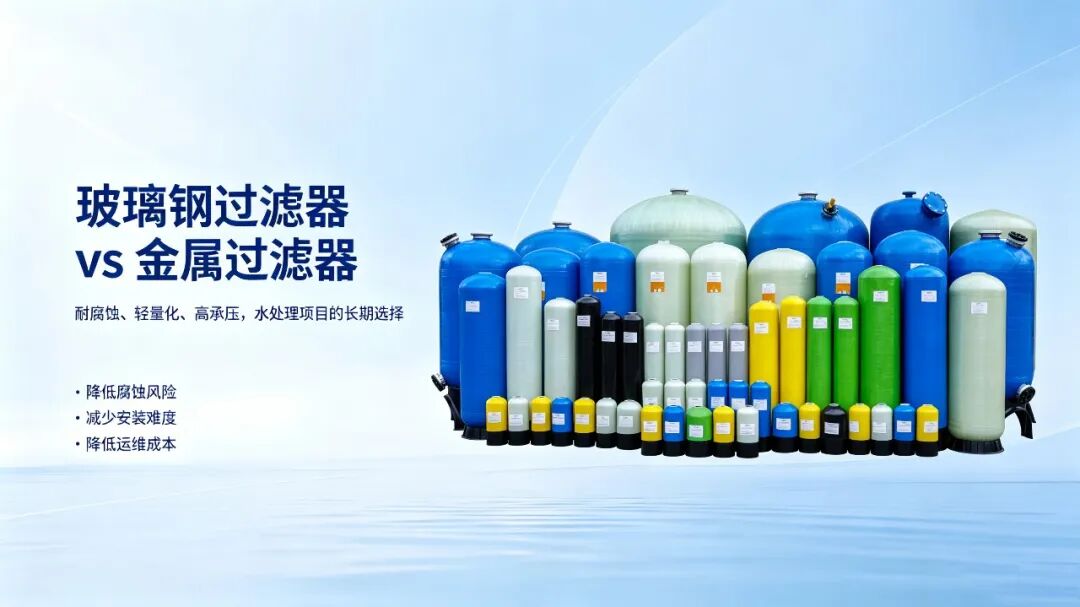
Filters are core pressure-bearing equipment for the stable operation of water treatment systems. Many purchasing clients raise the same question: in various water treatment engineering projects nowadays, there is a growing preference for fiberglass reinforced plastic (FRP) filters over carbon steel and stainless steel filters. What lies at the heart of this shift? It is not that FRP material is more fashionable. Instead, under most water treatment working conditions, it boasts comprehensive operational advantages superior to conventional metal vessels.
First, outstanding corrosion resistance greatly reduces long-term operation and maintenance costs.
Whether it is groundwater, well water, industrial circulating water, or corrosive water containing acid, alkali, high salt or high chloride ions, carbon steel tanks are prone to rusting and leakage during long-term operation, and may even develop perforations and be scrapped in severe cases. Even 304 and 316 stainless steel will suffer pitting corrosion in high-chloride and weak acid environments, and high-grade stainless steel comes with extremely high procurement costs. FRP is manufactured by winding composite resin and glass fiber, featuring excellent inherent anti-corrosion performance. No additional anti-corrosion coating is required. It maintains stable long-term operation under conventional water treatment media, significantly cutting maintenance expenses such as rust removal, anti-corrosion repair and tank replacement.
Second, light dead weight lowers the overall costs of transportation, installation and civil construction.
When comparing pressure vessels of the same specification, FRP filters are much lighter than carbon steel and stainless steel equipment. On one hand, logistics and transportation expenses can be saved. On the other hand, no large hoisting equipment is required on site, reducing construction difficulty. It is especially suitable for renovation projects with tight construction schedules, limited space and weak foundation bearing capacity. Metal tanks have substantial dead weight and require reinforced civil foundations, bringing extra civil engineering investment. FRP vessels can avoid such hidden costs.
Third, high pressure-bearing capacity breaks the misconception that “FRP is just plastic”.
Many people mistakenly believe FRP lacks sufficient strength, which is a typical misunderstanding. High-quality FRP filter tanks manufactured by continuous filament winding technology feature mechanically optimized structures, with a normal working pressure up to 150 PSI, equivalent to mainstream metal filters. They are fully applicable to most water treatment systems, including municipal water supply, industrial pure water and boiler feed water.
Nevertheless, whether an FRP filter tank can operate stably for more than ten years depends not merely on the material itself, but on the overall production process. Every procedure directly determines the service life of the tank, including resin formula proportioning, tension control of fiber winding, high-temperature curing process, forming of food-grade PE inner liner, integrated reinforced flange structure and factory hydrostatic burst test. FRP filter tanks with similar appearances on the market vary greatly in price, which essentially stems from differences in raw material standards, production techniques and testing specifications.
When selecting products, customers should not only focus on the upfront purchase price, but calculate the comprehensive life-cycle cost. A qualified FRP filter manufactured with standardized processes and complete testing can run steadily for over ten years with almost no extra maintenance costs. In contrast, low-quality cheap tanks or metal tanks with failed anti-corrosion layers will face frequent leakage repairs and premature replacement, leading to higher long-term investment.
With the upgrading of domestic environmental protection standards, water treatment systems impose increasingly stringent requirements on equipment stability and long-term operation performance. Benefiting from core advantages such as corrosion resistance, light weight, qualified pressure resistance, long service life and low maintenance costs, FRP filters are now widely used in industrial pure water production, boiler feed water treatment, groundwater purification, municipal water supply, food & beverage production and chemical pretreatment. Although sanitary-grade stainless steel is commonly adopted for sterile terminal processes of pharmaceutical purified water, FRP tanks remain the preferred choice for front-end pretreatment filtration.
As a professional manufacturer of water treatment filtering equipment, we always prioritize product quality. We implement standardized full-process control covering incoming raw material inspection, winding forming, curing processing and factory hydrostatic pressure testing. Fundamentally, customers purchase equipment to obtain a long-term stable, worry-free and cost-effective water treatment solution. Premium FRP filters can not only ensure normal water output upon commissioning, but continuously cut customers’ operation and maintenance expenses throughout years of operation and deliver long-term value. This is the fundamental reason why FRP filters are the top choice for the vast majority of water treatment projects nowadays.