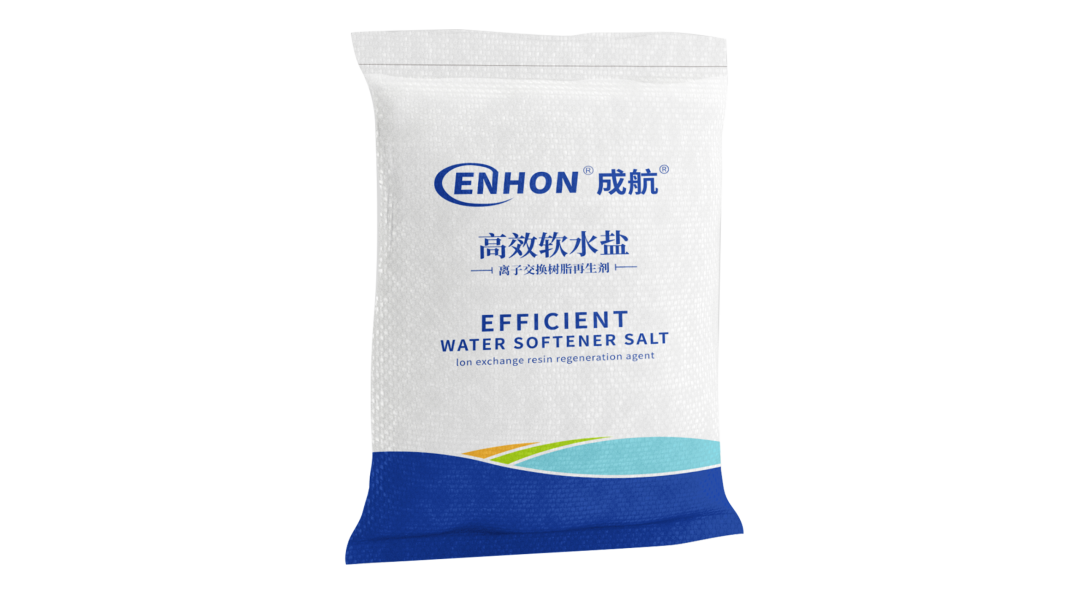
Water softener salt is a key auxiliary material in the water softening process.
Its core function is to regenerate ion‑exchange resins, thereby achieving water softening.
Most people are aware of its function yet lack professional understanding of its working mechanism.
Based on the principle of ion exchange,
this article elaborates on the working logic of water softener salt and related key points.
01 Working Mechanism and Regeneration Requirements of Ion‑Exchange Resins
Water softener salt, also known as an ion‑exchange resin regenerant, does not directly soften water.
Its core function is to restore the softening capacity of ion‑exchange resins.
As the core component of water softening equipment,
ion‑exchange resins contain a large number of active groups (e.g., sulfonic group –SO₃H),
which undergo ion‑exchange reactions with hardness‑causing calcium and magnesium ions in water.
Taking strong‑acid cation‑exchange resin (R‑SO₃H) as an example,
the exchange reaction equations are as follows:
2R‑SO₃H + Ca²⁺ = (R‑SO₃)₂Ca + 2H⁺
2R‑SO₃H + Mg²⁺ = (R‑SO₃)₂Mg + 2H⁺
With prolonged operation,
hydrogen ions (H⁺) on the active groups of resins are gradually replaced by calcium and magnesium ions,
leading to continuous decline in exchange capacity. Once the resin adsorption reaches saturation,
regeneration is required to restore its activity,
and water softener salt serves as the key medium for this regeneration process.

02 Core Process of Ion‑Exchange Resin Regeneration by Water Softener Salt
The essence of resin regeneration using water softener salt lies in the reverse ion‑exchange reaction.
Sodium ions displace calcium and magnesium ions adsorbed on the resin to restore its ion‑exchange capacity.
The process consists of three key steps:
Step 1: Preparation of regenerant brine
Dissolve water softener salt in water to prepare a salt solution with a concentration of approximately 10%.
Excessively high concentration leads to material waste and resin damage,
while too low concentration reduces regeneration efficiency.
Step 2: Reverse ion‑exchange reaction
Bring regenerant brine into contact with saturated resin to trigger reverse ion exchange.
Taking sodium chloride (NaCl), the main component of water softener salt, as an example,
the regeneration reaction equations are as follows:
(R‑SO₃)₂Ca + 2NaCl = 2R‑SO₃Na + CaCl₂
(R‑SO₃)₂Mg + 2NaCl = 2R‑SO₃Na + MgCl₂
Sodium ions (Na⁺) in the brine displace calcium and magnesium ions on the resin,
converting the resin back to its sodium‑form active state and enabling it to exchange calcium and magnesium ions again.
Step 3: Resin rinsing
After regeneration, thoroughly rinse the resin with clean water to remove residual calcium,
magnesium ions and regeneration by‑products (calcium chloride, magnesium chloride) on and inside the resin.
The resin is regenerated and ready for normal operation once the hardness of rinsing water meets the standard.
03 Common Question: Does Softened Water Taste Salty?
Under normal operating conditions, softened water does not have a perceptible salty taste.
The ion‑exchange process is controllable,
and the concentration of sodium ions entering the water from water softener salt is extremely low,
far below the sodium content standard for drinking water, making it undetectable by taste.
A noticeable salty taste may only occur if equipment malfunctions (e.g., aging or damaged resin) disrupt the exchange process,
allowing excessive sodium ions to enter the water.
In such cases, prompt equipment maintenance is required.
Professional Tip:
High‑purity special‑purpose water softener salt should be used to prevent impurities from clogging resin pores,
impairing regeneration efficiency, and extend the service life of resins and water softening equipment.
In summary, the core function of water softener salt is to regenerate ion‑exchange resins.
It restores the water‑softening capacity of resins through reverse ion‑exchange reactions to achieve water softening indirectly.
It does not act directly on water, and will not cause water to taste salty under normal use.