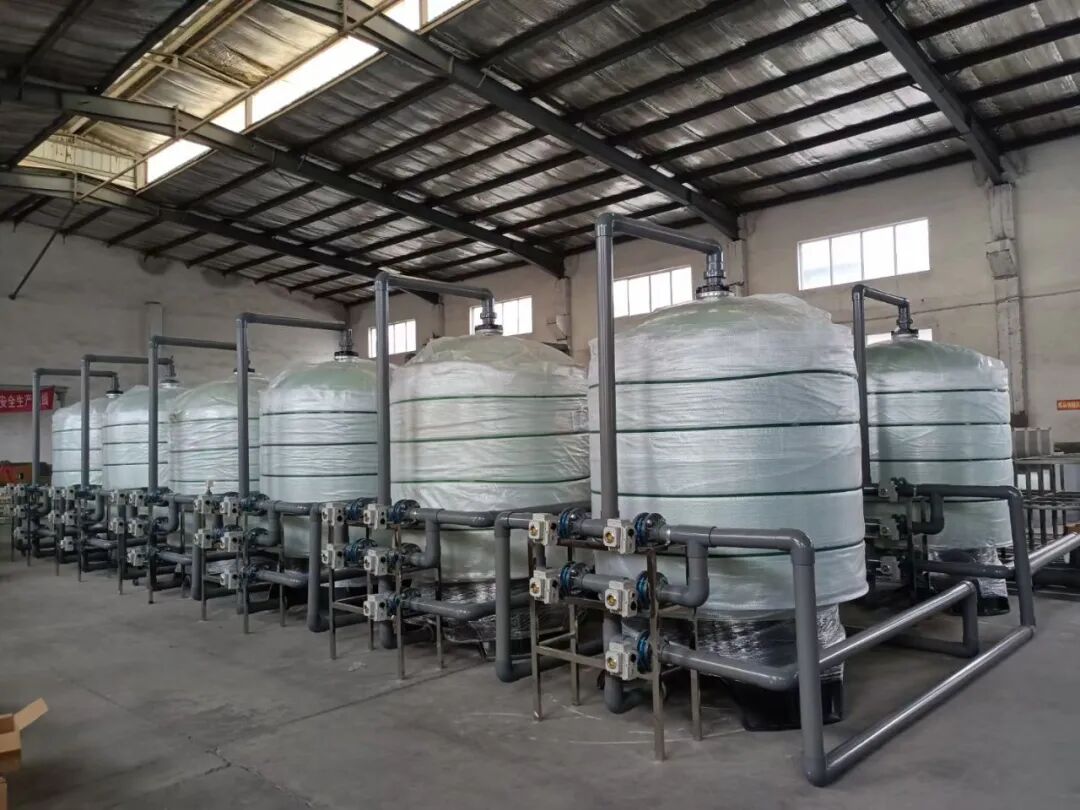
FRP tanks are non-metallic liquid storage equipment fabricated by filament winding with resin and glass fiber as raw materials. Featuring corrosion resistance, high mechanical strength and light dead weight, they are widely used in chemical, environmental protection, water supply & drainage, food and other industries.
The theoretical service life of FRP tanks ranges from 9 to 16 years. Integrally wound tanks with superior manufacturing craftsmanship can achieve a service life exceeding 15 years, while conventionally produced tanks generally last 6 to 8 years. The actual service lifespan is subject to raw material quality, production technology, foundation installation, operational specifications and service environment. Standardized design, installation and maintenance can effectively ensure stable tank operation and extend its service cycle.
This paper systematically analyzes the root causes of aging, leakage and damage of FRP tanks, introduces the structural principle of tank laminated layers, and elaborates on the standardized adhesive repair process, providing professional references for routine equipment operation, maintenance and fault remediation.
PART 01
Service Characteristics & Common Operational Hazards of FRP Tanks
Integrally wound FRP tanks feature excellent positive pressure resistance yet relatively poor negative pressure tolerance. Such structural characteristics become more prominent for large-diameter tanks above 2000 mm in diameter. Most on-site FRP tank failures are triggered by excessive negative pressure. During liquid pumping operations, blocked or poorly functioning vent holes create negative pressure inside the tank, resulting in tank implosion, cracking and deformation — the leading cause of tank damage. Accordingly, keeping vent openings unobstructed and maintaining atmospheric pressure inside the tank is critical to extending service life.
Furthermore, the structural configuration of finished FRP tanks is fixed. Frequent relocation damages axial stress of structural laminates, reduces overall tank strength and accelerates aging and breakdown. Random shifting shall be avoided during routine operation and maintenance.
PART 02
Root Causes of Aging, Leakage and Damage of FRP Tanks
When FRP tanks suffer from aging, leakage or damage faults, the root triggers fall into three categories: open-air environmental corrosion, fatigue caused by alternating temperature changes, and concentrated structural stress. Alternating stress generated during equipment operation will further accelerate fault deterioration.
1. Long-term Erosion from Open-air Exposure
FRP tanks installed outdoors are persistently eroded by UV radiation, wind, rain, frost and ice in alternating conditions. Ultraviolet rays degrade surface resin of the tank and reduce material strength. Continuous washing and water penetration from wind, rain, snow and frost accelerate deterioration of surface resin, leading to dissolution and erosion of internal glass fibers. Consequently, the tank develops chalking, microcracks and leakage, greatly shortening its service life.
2. Structural Fatigue Induced by Alternating Temperature
Direct sunlight plus diurnal and seasonal temperature fluctuations result in repeated thermal expansion and contraction of the tank body and induce structural fatigue. Tiny voids and air bubbles remaining after tank forming keep expanding under varying temperatures, damaging the overall tank structure and lowering pressure-bearing capacity, which gradually leads to microcracks and seepage.
3. Structural Damage Caused by Stress Concentration
Gas-phase molecules inside the tank feature high activity and easily penetrate tiny internal structural gaps, accumulating at defective locations to form stress concentration. Long-term accumulation eventually causes local cracking and damage. Besides, repeated liquid level fluctuation during storage subjects the tank to continuous elastic deformation and cyclic alternating stress. At the joint between tank head and cylinder shell, existing microcracks spread rapidly under shear force from supports, medium extrusion, self-weight and external impact, eventually resulting in extensive leakage and structural failure of the tank.
PART 03
Principle of Layered Structure of FRP Tanks
FRP tanks adopt a multi-layer composite structure with distinct material composition and functional purposes for each layer. Structural integrity directly determines the tank’s anti-corrosion, pressure resistance and weather resistance performance. The tank mainly consists of three sections: liner layer, structural strength layer and outer surface layer.
1. Liner Layer
Composed of inner surface layer and secondary inner layer, the liner serves as the core structure for anticorrosion and anti-seepage of the tank. It is fabricated from highly corrosion-resistant resins such as bisphenol-A type resin and vinyl ester resin together with glass fiber surfacing mat and chopped strand mat, effectively isolating stored medium and protecting the inner structure against corrosion and penetration.
2. Structural Strength Layer
As the main load-bearing component of the tank, the strength layer uses general unsaturated polyester resin as matrix and roving woven fabric as reinforcement material with resin content controlled between 45% and 50%. Its thickness is designed in accordance with tank pressure requirements and governs the tank’s compression resistance, impact resistance and overall load capacity.
3. Outer Surface Layer
Working as the exterior protective coating, the outer surface layer adopts weather-resistant resin and ultra-thin glass fiber with resin content ≥55% and thickness ranging from 0.2 mm to 0.5 mm. It resists erosion from UV radiation, rain, wind and temperature variation, shields inner laminates and slows tank aging.
4. Mechanism of Tank Medium Penetration
Tank leakage is mainly triggered by penetration of small-molecule medium, with medium molecular weight and temperature difference across the liner as key contributing factors. Optimizing resin formulation and curing process during production can efficiently reduce permeability and thermal expansion coefficient, prevent liner delamination and cracking, and improve structural stability and repairability of the tank.
PART 04
Standard Adhesive Repair Process for FRP Tanks
Local leakage and minor damage on FRP tanks do not require full tank replacement. Featuring mature technology and cost-effectiveness, the adhesive bonding repair can effectively restore sealing performance and structural strength of damaged areas. Standard operation procedures are specified as follows:
Step 1: Cleaning & Pre-treatment
Thoroughly clean dirt, residual liquid and water stains around damaged areas; partially dismantle accessories if needed, then air-dry thoroughly in ventilated space to guarantee the repair zone is dry, clean and free of contaminants.
Step 2: Glass Fabric Cutting & Preprocessing
Cut glass fiber fabrics to match the dimension of damaged sections. Remove wax from fabrics via baking until no smoke emits during heating. Keep fabrics flat throughout the process to prevent folding or grease contamination.
Step 3: Special Adhesive Mixing
Blend epoxy resin and polyamide resin at a 1:1 ratio and stir fully until homogeneous; qualified adhesive shows no wire drawing when lifting the stirrer. Prepare adhesive on demand to avoid waste from premature curing caused by excessive preparation or prolonged standing.
Step 4: Layered Gluing & Fabric Lamination
Coat the inner tank wall at damaged spots evenly with prepared adhesive, attach glass fabric flat onto the coating and compact gently to squeeze out trapped air and hollow voids, ensuring full resin impregnation into fiber cloth. After full adhesion of the first layer, repeat gluing and layup procedures. Apply multiple layers according to damage severity and control repair thickness properly to avoid uneven curing or surface bulges from excessive local build-up.
Step 5: Natural Curing & Post-finishing
Allow repaired parts to cure naturally under ambient temperature; open-flame baking is forbidden to avoid material carbonization and structural deterioration that compromise repair strength and service life. Once fully cured, grind the edges of repaired area smooth, and carry out hole cutting or anti-corrosion painting as required. The rehabilitated tank can resume full operational performance.
PART 05
Operation & Maintenance Summary and Protection Recommendations
Most aging and damage of FRP tanks stem from negative-pressure damage, environmental corrosion, stress fatigue and improper operation rather than spontaneous material aging. Routine maintenance measures including keeping vent holes unblocked, prohibiting arbitrary relocation, implementing outdoor anti-aging protection and regular crack inspection can effectively prolong the equipment service life. Minor leakage and partial damage can be repaired via standardized adhesive bonding technology to sharply cut replacement cost. In case of structural failures such as large-area deformation or severe cracking, condition assessment shall be conducted promptly and tank replacement arranged when necessary to ensure safe and stable production.